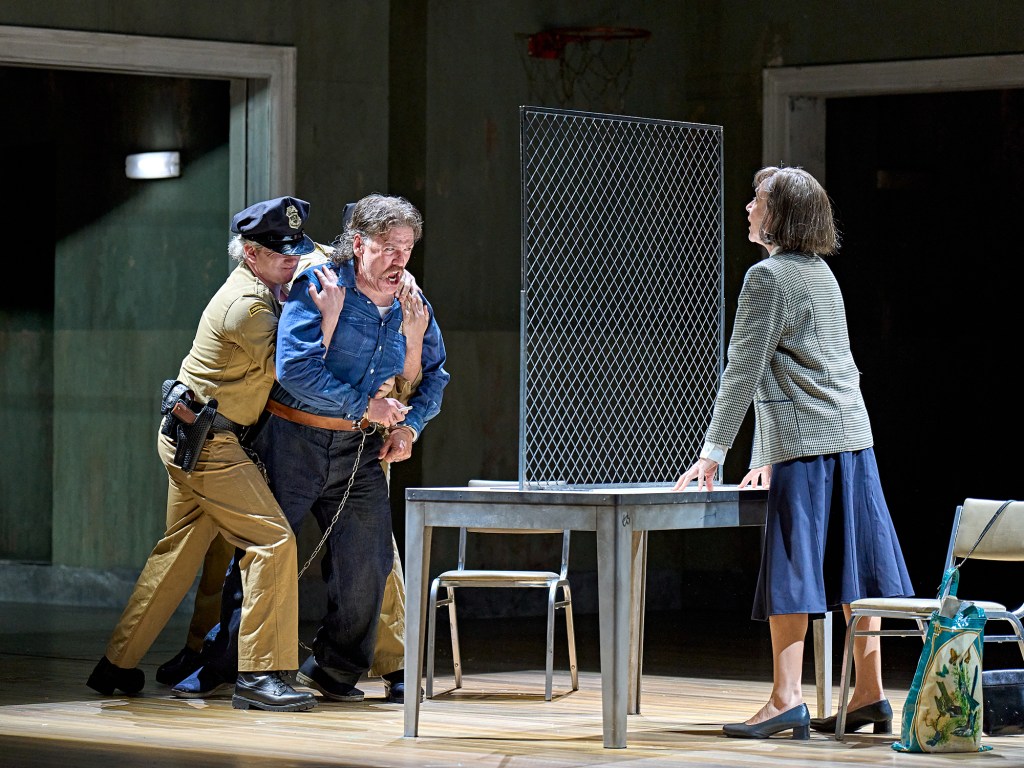
Jake Heggie’s masterpiece of an opera based on the 1995 film of the same name bursts to life on the Coliseum stage and its incredible examination of justice and humanity will resonate with me for a very long time…
I was very excited when I first saw this announced by the ENO. It was already a renowned opera having been staged in America multiple times, and upon announcement of a debut in England I was very eager to see it. It is based on a 1995 film and follows the story of Joseph De Rocher who has been sentenced to death for the murder and rape of a young couple and his journey of faith and confession with the help of his spiritual guider, Sister Helen Prejan. I had never seen the film but my word, this was such a powerful and deeply moving story that leaves the whole audience so incredibly moved and the way it was staged was hauntingly done by the ENO. This was a fabulous production of an absolutely beautiful opera.
I will begin by talking about the composition of the Opera. Heggie creates this vast soundscape infusing different genres into his music to really punctuate the shifts of emotion or location. For example, in a touching scene between Sister Helen and Joseph, they recount their memories of Elvis Presley, and Heggie weaves elements of jazz and rock and roll into the Opera. I thought the story flowed in a brilliant way, we got to see both sides of the story, from Joseph’s perspective to his mother’s and then the victims parents as well, with all of these moments powerfully scored by Heggie.
Terrence McNally’s writing really fleshes out the characters of the opera, they have moments where they may speak rather than sing or have a burst of emotion that gives the audience an insight into their character, it is very clever and adds to the poignancy of the message.
This is such an emotional and moving Opera and a very difficult story. I struggled to watch the first scene in which Joseph and his brother emerge from the audience and we have to witness their unforgivable crime and I had to shut my eyes when Sister Helen was confronted by the parents of the victims for helping Joseph. McNally and Heggie force us to think about justice and make the audience look at the topics it discusses, they don’t try and shy away from the detail which is why I think it comes across in the way it did.
The final scenes where we see Joseph injected and he finally confesses and tearfully apologises (in spoken voice) to the family of the victims were so emotional and I admit I cried a lot. Not just because of the powerful staging of these scenes and the acting I was witnessing but also the music that accompanied it. I thought it was one of the best endings to an Opera I had seen. As the lights went down and the curtain dropped i just looked down, I needed a couple of moments to really recollect my thoughts it had shaken me that much!
The singing was incredible from all of the opera singers but what I thought was interesting is that their acting was also brilliant as well. Each of them deeply understood their roles, and whilst they sang the difficult darting tunes of Heggie’s music they placed motivation behind McNally’s words as well. I loved Christine Rice as Helen, she has such a pure and angelic voice and the role is so challenging to perform but she does it with ease. She shows the Sister’s conflict with faith and morality and she takes the audience on the journey with her, a really tremendous operatic performance.
Dame Sarah Connolly was heart-breaking as Joseph’s mother, as she tearfully tells him to smile so she can remember him as just her “little joe” and not the monster he had turned out to be. The pair of parents were superb but specifically Jaques Imbrailo who was a tour de force as Owen Hart, a man who has not only lost his daughter but has also parted ways with his wife.
The real star was Michael Mayes as Joseph De Rocher, physically dominating with tattoos down his arms, but inside he is a man scarred and hurt by his actions which he buries deep within him and replaces it with arrogance and bravado. Michael Mayes plays the anger of De Rocher but it is an anger that the audience can identify as not being against anyone else but himself. As he reaches his execution date he finally confesses to the murder of the young girl and boy as he symbolically curls up on the floor like a child, showing us a raw reflection of the real Joseph: very scared.
Michael Mayes’ voice is booming yet he has the ability to soften it as he sings of his guilt. The stark contrast shows his transformation in faith, and as he passes he gives one final breath as the auditorium falls silent.
MY VERDICT:
Wow! This was a difficult review to write because it is actually so difficult to describe how beautiful this opera was, and you may have noticed I haven’t really mentioned costume or stage because that didn’t matter to me. I was engrossed in the story purely by the actors, the direction (Annilese Miskimmon) and just the pure beauty of the story encapsulated so wonderfully by an absolutely world class composer. This is an opera that is hard to watch but in the right way, it challenges your opinion and puts you face to face with difficult questions. I will continue to think about Dead Man Walking for a very long time..


Leave a Reply